Saturday, 2 April 2011

Eastern Europe Day 5 Fri 18/3/11: Sarajevo to Dubrovnik

Woke up early to explore Yellow Fortress (Zuta Tabija). After eating the sweet Sarajevo tart for breakfast, I walked along Kovaci road. It was slight drizzling at that time. Along Kovaci is a cemetery where victims of war were buried. The years of death were mainly 1992-1995. The view from Zuta Tabija is of the Sarajevo city. Met Tokiko at the Sibilj Fountain and we walked around Bascarsija together. It was raining slightly heavier and cold so we took refuge in a small lovely Turkish cafe where Tokiko had her Turkish coffee while I ate my Sarajevo sweets. The sweets are too hard for my weak teeth...I actually broke my tooth filling.


I only left with 0.45 Bosnia marka and the lady at the hostel reception kindly donated me another 60 cents to buy one bottle of mineral water. Tokiko and me boarded Tram 1 to go to the bus station (it stopped at the railway station). The bus to Dubrovnik departed on time.


The view of Bosnia countryside is very scenic. Rolling green hills with emerald river and myriads of bridges offer very photogenic view.

Once arrived in Dubrovnik, Tokiko and me walked towards the ferry port to enquire about ferry schedule to Mljet. To my disappointment, the ferry kiosk to Mljet is closed! It was another 15minutes walk to the Youth Hostel which is located uphill. Poor Tokiko...her bag is much heavier than mine. Worst, by the time we reach the hostel, the reception was closed. During winter, it is only open for certain hours of the day. So we walked to the fort with our rucksack.

In the stari grad, we explored the Cathedral, Sponza Palace and the pier (boats to Locrum). We bought some food to cook in the hostel and took a bus to the hostel. Back in the hostel, met Hideaki, a friend that Tokiko got acquainted in Zagreb. He never fail to make me laugh. A happy go lucky fellow, he is traveling around Europe for 5 months. Ironically, he has climbed Mount Kinabalu and Everest but not Mount Fuji. Later, we travelled together to Kotor and met again in Skopje. The night was fun because it is only three of us in the hostel. With the background of famous Japanese songs, some I recognized from watching Japanese dramas, we chatted the night away. It is like a small Japanese tea party :)

Eastern Europe Day 4: Thu 17/3/11: Bosnia: Sarajevo

Crap! It was 835am..I overslept. I was overly ambitious. I slept at 3am and planned to wake up at 6am to climb Marjan Hill. Scrambled to my feet and got ready in a gusto.  Ran like a headless chicken to the bus station. I had to pay extra 40kuna to secure a bus ticket to Sarajevo. The bus is empty except me and another Bosnia young man who just returned from Europe tour and reached Split via ferry from Ancona.

The bus journey was very long...lasted 7 hours. I struggled to stay awake because the view is breathtakingly beautiful. Croatia is reknown for its coastline. Sapphire blue sea dotted with rugged rocky mountains looks amazing in every photo shoot. The stretch between Mostar and Sarajevo is also memorable. On arrival to Sarajevo bus station, I walked to the railway station to get a free pickup to my hostel in Baseskije. Sarajevo is beyond my imagination and expectation. It is a remarkable city, with heritage from Ottoman-Turk and Austrian-Hungarian mixed with scars from the recent Balkan war. It is tragically beautiful. I walked along river Miljacka admiring the bridges and the buildings. On Mula Mustafa street, one can see a mixture of Catholic church, Jewish and Orthodox church and mosques. Unfortunately, the beautiful City Hall is under renovation. There are evidence of bullet holes in some of the buildings. Along Ferdahija are the posh and modern buildings that were built postwar.

After sunset, I searched Bascarsija for local food. Ate in Dzenita Restaurant and had sarajevski sahan (stuffed vegetables with meat), loza rakija( local fire spirit) and baklava. All in a very affordable price. Bascarsija is a fun place to explore at night. Lots of lovely cafe and shops selling trinkets and stuff. It is sad that I do not have enough time for sarajevo. I really wanted to visit the Tunnel Museum. The tunnel which is also nicknamed Tunnel of Life is the passage below the airport where people headed for safety during the war to escape the snipers.

Back in hostel, I met Tokiko. She is a nurse back in Japan. This amazing woman actually climb the hill in Medugorje in heavy rain. She has travelled around Africa alone. We chatted a bit before retiring early.


Sebilj in Bascarsija


Sarajevski Sahan 

Bosnia countryside


Eastern Europe Day 3: Wed 16/03/11: Croatia: Split and Hvar

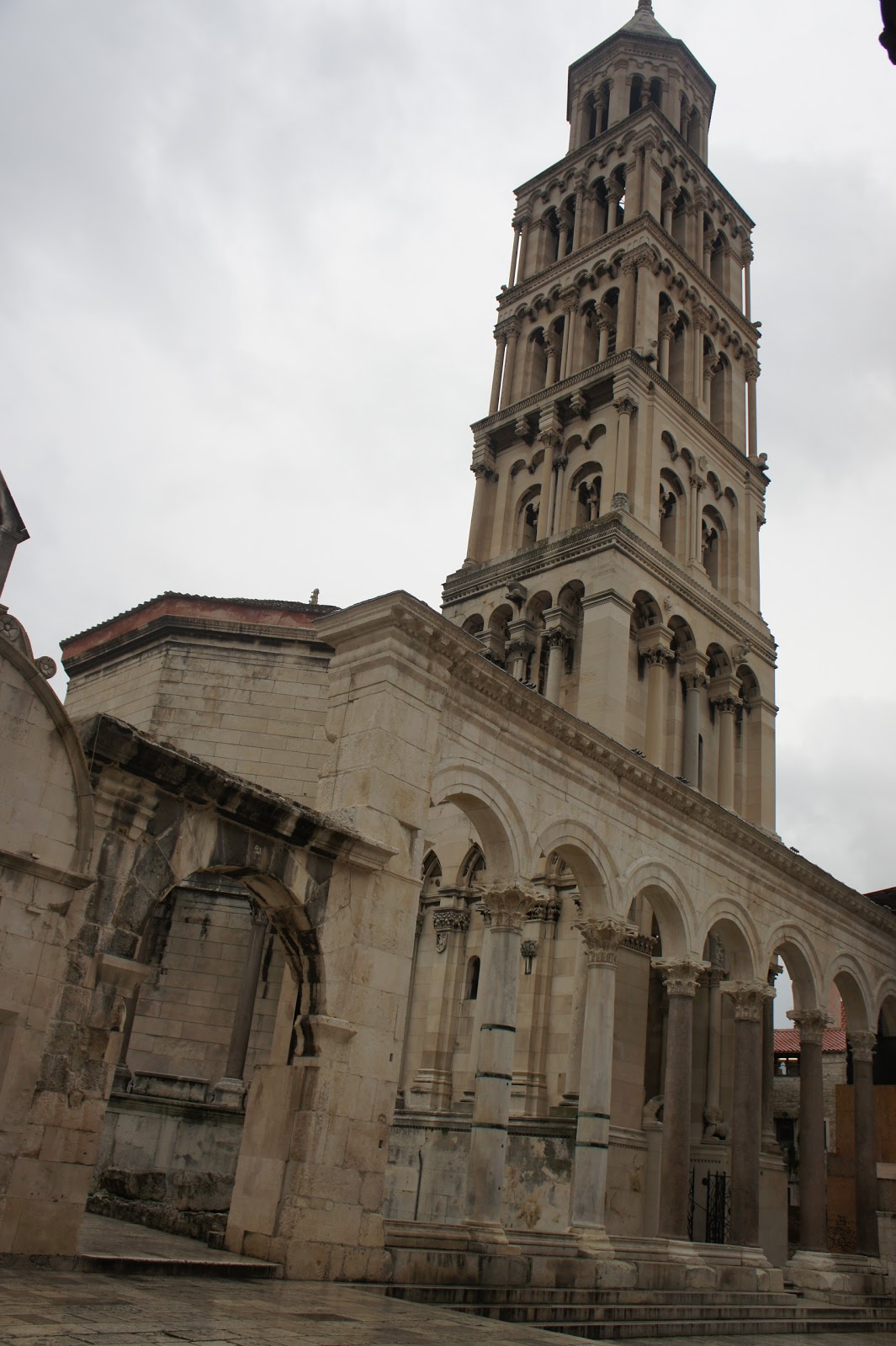
Up early to explore the Split stari grad. The weather was horrible. It started raining and it was cloudy. Crossed Narodni Trg to enter the grad from Iron Gate. Reached Diocletian's Palace within a minute. It is indeed a majestic structure located in the middle of the grad. There is an old church besides the Roman ruins and a vestibule underground where vendors sell handicrafts and paintings. Since it is raining, there was nothing much I could do. I could not go hiking at Makarska nor Marjan Hill.


I was reluctant to stay indoor hence decided to board a ferry to Hvar, which was a big mistake. The rain became heavier and the wind became more ferocious. By the time I reached Hvar, it was like a mini storm. To make things worse, I went to the toilet about the time of disembarkation and I missed the one and only bus to Stari Grad and Hvar town. I did not realize that bus from ferry to town is only 3 times a day and correlate with ferry arrival and departure. The taxi from the port to town cost euro20 about 3 times my ferry ticket. I tried to ask for a lift from the locals that dropped by the port to buy ferry ticket but all refused to help. Even the ticketing officers were not helpful. Stranded at the port for about an hour and there was no sign of rain becoming lighter or stopping. So, I decided to walk to Stari Grad...with my umbrella. It was very difficult to walk against the wind...and all the time I was thinking about the tsunami victims in Japan and how horrible they must have felt. Was praying to God all the time to reduce the rainfall but God gave me better. About 10 minutes of walk, a Croatian man drove by and stopped me and gave me lift to town without me asking. Bless him. He dropped me off at Stari Grad. Off season, there is nothing much to do there really. It is a quaint and peaceful little village. Charming in a way. I explored the waterfront and walked around the town. Discovered a small church and Dminikaski Samorstan, a monastery that functions as museum now (closed). There is a bus from Stari Grad (old town) to Hvar town at 2pm so while waiting for the bus, I bought some food in supermarket to eat. 


The journey from Stari Grad to Hvar town was along the coastline hence was rewarded with scenic view. Thank God, the rain has stopped. From far, one can see the imposing structure of Hvar fortress. It is a very attractive resort town. Off season, it is peaceful and relaxing but during summer, it can get very crowded. The public toilet was locked hence I walked to hotel at the waterfront to use its toilet. The massive square at the centre is called Trg Svetog Stjepana and Cathedral of St Stjepan is one of the important landmark there (closed). Since museums and cathedral are closed, the only thing left to do is to climb the hill to reach Spaniolar, a citadel built on site of a medieval castle to defend the town against the Turks. From the top of the hills is a bird eye view of Hvar town, Adriatic sea and nearby islands. 


Descended the hill in time to catch the bus back to ferry port. Left my umbrella at the bus stop :(
While waiting for the ferry, I noticed how clean is the water at the ferry port. Not polluted at all and not a single rubbish seen compared to Locrum port in Dubrovnik. I was impressed. Made me wonder was it because it was off season...


It was nightfall by the time I reached Split. Bought bus ticket to Sarajevo and changed some pound to BAM (Bosnia currency). Had pita bread with squid for dinner. I love squid! Explored the stari grad again and the night view of Roman ruins at night is even more attractive than daytime.
Slept late again...


Diocletian's Palace, Split

Hvar fortress from far


Eastern Europe Day 2: Tue 15/03/11: Croatia: Plitvice National Park

Set out at 6am to explore medieval Gradec in upper town (Gornji Grad). It was an uphill walk along Radiceva road. I turned into Opaticka and passed by the Stone Gate before reaching the iconic St Mark Church with tiled roof displaying Croatia coat of arms and emblem. From there, it was a short walk to Jesuit Church of St Catharine at Katarinin Trg. Behind the church is a Strossmayer square which is a perfect place to get sunrise view of Zagreb city. There is a very short funnicular that one can take from Ilica all the way up to the Katarinin Trg. Rushing for time, I walked down the verdant staircase to reach Mesnicka and boarded a tram to the bus station.

The bus to Plitvice departed on time. My experience with Croatian buses were good...no delay at all. The countryside view is beautiful. Arrived at Plitvize Jezeru on time. Besides me, there were 3 more Japanese in the bus that alighted at Plitivice. The bus stopped outside station 2 and continued its journey towards Split. The first building one would see is a post office on the left and a bridge on the right. It is a short walk (about 5 minutes) to reach the P2 station booth. Passed by few hotels on the way. It was off season hence no buses nor ferries. So, the admission was free! In summer, the admission fee is 70 kuna inclusive of bus and ferry rides between P1 to P4. P1 is at the lower lake and P2-P4 stations are for the upper lakes. Even the public toilet was closed...I had to go to the toilet in the hotel. One of the hotel staff advised me to just go around P2 and walk to P1 because the upper lake is too massive to explore on foot. I am glad that I did not follow his advise. With rucksack on my back, I walked toward the ferry stop at Gradinsko Jezero. There is a small waterfall at the turquoise lake. Then I followed the bus road and walked towards P3 station. The view along the way is breathtaking. And the view that appears near P3 is even heart stopping. I felt like I found paradise on earth. There is no words to explain how exhilarated I was when I found the series of waterfall that cascading from Galovac Jezeru. A truly amazing view. The water is crystal clear and of various shades of green and blue. No one is allowed to swim here and the reason for the colour is minerals formation at the bed of the lake. It is a heaven for geologist and naturalist. There is wooden path along Galovac Jezeru and along the waterfalls like Galovacki Buk and Veliki Prstavac. The hike towards P3 from P2 and return took about 2 hours. I had time to walk to P1 and take bus from there but I was worried that I might not be able to find the bus stop at P1 and miss the bus to Split. I was tired too. So I took my time and walked to the bus stop. Ate my packed lunch while waiting for the bus to Split. Two Japanese girls joined me.

Arrived in Split at night. The bus station is located next to the train station and near the ferry port. The Grad is only 5 minute walk away. The Premi guesthouse that I booked online is just outside the grad. The lady who owns the guesthouse is very kind and warm. She even lent me her laptop to use...which was really useful because I managed to book hostels for Greece. I had the room all by myself which is great. The landlady recommended a local restaurant named Fife and luckily, I managed to find it despite it was quite dark and it is located at the corner. Had a sumptuous dinner of traditional Croatian food of dumpling and beef with gravy. Very filling indeed. Slept late...
Plitvice National Park


Eastern Europe Day 1: Mon 14/03/11 Croatia: Zagreb

This 14 days backpacking trip had been quite stressful...the planning was not easy either.
For Croatia, I was still able to plan my bus journeys since there is good bus website which gives information about buses going to Bosnia as well but there is constant worry whether the schedule online is the updated version. For Macedonia, it was really challenging because the bus website is in Macedonian language and I had to get a Bulgarian nurse to translate it for me. The best part was I had to ask her to call Skopje to confirm the timing...which was a wise thing to do because the schedule displayed online was not the updated version (off season buses are less frequent obviously). And another bombshell dropped was the fact that the Greek railways stopped their train service between Skopje and Thessaloniki in mid Feb and I only found out about it few days before I flew to Zagreb. I was tearing my my hair off thinking of a solution to get to Thessaloniki from Skopje. The bus from Skopje to Thessaloniki only runs on Mon, Wed, Fri 6am. Unfortunately, my journey was planned in a way that I would be in Macedonia on tuesday and had to catch a flight to Mykonos on wednesday morning...I was extremely distressed but things worked their ways out with God's divine help. Another problem I faced during off season travel in Eastern Europe is the lack of public toilet. All public toilets are closed. Even some museums do not have toilet for tourists which I think really unfair. Facilities for tourists in Eastern Europe really need to improve in order to compete with western Europe countries.

I had very little sleep few days prior to the  travel day. In fact, I only slept for half an hour before catching the flight to Zagreb. The flight was slightly delayed but uneventful. On arrival to Zagreb airport, I was a bit shocked. It is unbelievably small and basic. There is only one room in the toilet before passing the custom checkpoint...and though it was during office hour, the tourist information counter was not manned (in fact, it was locked) and the money changer does not sell BAM notes in which I was surprised because Bosnia is a neighbouring country. I could not get information about the tram network nor buy a 24 hour Zagreb card. There are shops inside the airport that sells Zagreb card but only 72hours card are available...

Getting a bus from the airport to the central bus station (autobusni kolodvor) is easy though. The stop is just outside the exit point of the airport and bus fare is 30 kuna. However, once I reached the bus station, it was quite a headache. Fortunately, able to find direction from Croatian who speaks simple english. Found my way to the ticket counter and purchased bus ticket to Plitvice. It was extremely confusing..the counters are numbered but no signage present to inform customer which counter is designated to which destination...I was directed to 3 different counters before reaching the correct counter.

The worse was yet to come. Once outside the bus station, I was completely lost. I could not find the hostel that is near the bus station and decided to go the city centre. Standing at the tram stop, I was there for good ten minutes trying to figure out which tram goes where and which direction to go for...A tram map from tourist info centre in the airport would be extremely helpful. I gave up trying to figure out the tram network and asked a young Croatian girl about which tram to board to the Trg Josipa Jelacica. Most young generations in Croatia can speak decent or simple English. I boarded tram 6 happily just to find that driver did not have day tram pass! I had to get down and cross the road to nearest tissak to buy the tram pass (25 kuna, day pass only valid till 3 am next day, need to validate with ticket machine inside the tram). It is important to note that tourists should buy bus ticket or tram tickets from tissak because it is cheaper.

It was 2pm by the time I reach the famous square. Dolac market was still open but I did not have time to explore it. Fortunately, Fuhlir hostel was very easy to find. Checked in and dropped my rucksack in the room. With tram map from the hostel, I could navigate around the city with no problem. I am not really a city person so the first place I headed for was Medvenica mountain. Hopped into tram 14 till its last stop and changed to tram 15 till its last stop. Then, I was stuck. I assumed that there would be a funnicular to go up to the top. That was a foolish assumption. Off season, the funnicular was closed and the station is actually located about few miles away. At the tram stop, I met a Croatian lady who directed me to go through a tunnel. So, I walked on the off beaten track towards the tunnel (sign posted as tunnelum). There were few old folks chatting outside the tunnel and that gave me courage. The tunnel is very creepy, reminded me a lot of the tunnel in Kakashi, a Japanese horror movie. After the tunnel, it is few kilometre hike through the woods but with good trails. After about near half hour, I saw the funnicular station. Met a group of Croatian men who told me that it would be another 2 hours (return) to reach the top of the mountain where Medvedgrad (fortress) is. At that point, I had to give up going to the top because I am worried I might miss the last tram that descend to the city. Well, the hike up the mountain was refreshing so it was a good experience after all.

Back in Ban Jelacic Square, I walked towards Kaptol Square to board bus 106 to Mirogoj cemetery. It is reputed to be one of the most beautiful cemetry in Europe. Since visiting Necropolis in Glasgow, I was fascinated with western cemeteries so I knew I had to visit Mirogoj. Unlike Necropolis, Mirogoj is modern with very well designed layout. There are beautiful sculptures and a big cross in the centre dedicated to fallen soldiers in war. It is interesting to observe the Croatian culture in relation to death. Very peaceful place to contemplate about life and death...

Returned to Kaptol square to explore the Zagreb Cathedral. One of the spire is under repair. Then, I took tram 12 to Maksimir Park. I should have alighted at Bukovacka stop but I had to walk a bit because I got off at earlier stop. It is a very old public park and was inaugurated in 1794. Massive and lovely, it is at its best during sunset. I actually prefer this park than Hyde park in London. It was dark by the time I reached Ban Jelacic Square. I was very tired due to sleep deprivation. Explored part of Ilica and bought multiple berry flavour ice cream in Vincek ice cream shop. Yummy! Shopped for food and drinking water before heading back to hostel.


Ban Jelacica Square

Mirogoj cemetery

Maksimir Park at sunset


Sunday, 13 February 2011

Portugal last day: Tue 25/1/11: Lisbon: Belem and Alfama

I had only one day for Lisbon hence no chance to visit Sintra, Setubal nor Cascais. After a good breakfast in Old Lisbon Hostel, I set out early to explore Lisbon. Crossing Praca Duque de Terceira to get to Cais do Sodre gave me an adrenaline rush. The buses, trams and cars were crisscrossing nonstop that I had to run for my life. Lisbon is a city that was built on seven hills hence the roads are steep and there are even elevators to help people get up and down these roads. It has very good public transport network but it is not easy to navigate your way if you cannot read nor speak Portuguese. Thankfully, I managed to get maps of trams, subways and buses from the tourist office in the airport on the night before. Hopped into tram no 15 with the rest of the morning crowd towards Belem.

Arrived near Torre de Belem (Tower of Belem). It is free entrance with Lisboa Card. Unfortunately, it is only open at 10am. Waited outside the door patiently. Even at 10minutes past 10am, the staffs still did not open the door despite a small group of tourists waiting outside the entrance. When knocked on the door, a staff appeared and gave an angry rebuff before slamming the door shut again. Such an attitude! Time is precious hence I gave up on the notion of entering the tower and took a bus to Centro Cultural de Belem. From there is a short walk to Praca do Imperios, a beautiful square in front of Mosteiro dos Jeronimos ( Jeronimos Monastery). Just across the road from the square is the Padrao dos Descobrimentos, a monument erected to mark the Portuguese Age of Discovery in 15th century.

Mosteiro dos Jeronimos is massive and is a must visit place in Lisbon. Founded in 1501, it boasts fine carvings and Manueline architecture. It also houses the tomb of Vasco da Gama, Luiz Vaz de Camoes and Alexandre Herculano. When I studied history of Portugal invasion in Malacca during school days, never would I imagined that one day I would be able to see the tomb of Vasco da Gama...
Mosteiro dos Jeranimos

Luckily, I was not too lazy to walk to Museu Nacional dos Coaches from the monastery because I found the Antiga Confeitaria de Belema !!! It has the best pasteis de nata (is named Portuguese tart in Msia) in Portugal. The taste of the custard tart is just out of this world and to eat it with cinnamon powder and icing sugar sprinkled on top is just amazing. After gobbled down two tarts at one go, I joined the long line again to buy other types of pastries though I must say only the pasteis de nata is truly memorable...

Happy with custard tarts in my stomach, I walked to the Coaches Museum. It is nothing like any museum I have visited before. Really one of its kind. It is fun to see all different types of coaches, litter, sedan chair and cabriolets. Reminded me of Cinderella and its pumpkin coach. Just near the exit is the landau used by King Carlos during his assassination in 1908 with bullet holes visible at the door.


Museu Nacional do Coaches

Left Belem with a bus to go to Praca de Figueira and from there took bus 737 to Castelo de Sao Jorge (Castle St George). It was founded in 11th century and it was here, King Manuel I welcomed Vasco da Gama upon his return from India. It has at least six towers and the view of Lisbon from top of the tower is great. There is also archeological site of iron age and moorish quartes and the ruins of the ground floor of the Palacio dos Condes de Santiago (Palace of the Counts of Santiago). The museum inside was built on the ground of former Royal Palace of the Alcacova which was severely damaged by earthquake in 1755.

Lisbon view from top of Castelo tower
 
Museu Nacional do Azulejo (Portuguese Tiles) is also a must see place. The only problem is there is no direct way to reach this museum. I took a subway from Praca de Figueira to Santa Apolonia and then bus to a nearby stop. Walked quite a bit and with help from a kind Portuguese man, found it alas. I absolutely love this museum. It is housed in the former Madre de Deus Convent so besides the massive collection of azulejos from mid 15th century to present days, it also has a church, Mannerist cloister, St. Anthony's chapel and Sacristy. The famous azulejos are Panel of Our Lady of Life, Great View of Lisbon (most complete iconography on the city before the 1775 earthquake) and Sao Bento staircase. The modern and contemporary azulejos are very interesting and is an eye opener.

By the time I finished, it was getting late. Rushed back to Cais do Sodre and climbed the steep Rua de Alecrim again to go back to my hostel. Then walked down again with my rucksack to catch a bus to the airport. Got down at the wrong stop because the driver did not understand what I was saying and I had to half run-half walk to the airport...

Safely boarded the plane and reached home late....

Next trip is Eastern Europe from Zagreb travelling south towards Greek Islands :)

Saturday, 12 February 2011

Portugal Day 3: Mon 24/1/11: Braga, Nazarre, Obidos

Being part of northern Portugal, Braga was as cold as 2-3 degree at night. I could not sleep well because the heating in the hostel room was not warm enough. Woke up in the middle of the night to add another layer of thick blanket. The breakfast was great though: 2 big bun with jam, milk and cereals, yoghurt and hot chocolate. Although the hostel provides free indoor parking at night, I had to remove my car from the courtyard by 9am to park at a nearby private car park. 


Braga is reputed as one of the most beautiful city in Portugal hence the crazy idea of driving up north despite having only 4 days to cover Portugal! It is a also a religious city with many sanctuaries nearby.


It was a short walk from the hostel to the city centre. The Praca de Republica is a large scenic square in front of the Igreja e Convento dos Congregados, Arcada and tourist office. The famous Braga cathedral is just few minutes away.  No photography allowed inside the Se though.


Left Braga early to visit Bom Jesus, a hilltop pilgrimage site with famous stairway. One can choose to climb the long staircase (pilgrims sometimes climb on their knees!) or hop into a funicular train to reach the top. It has few chapels, allegorical fountains, a church and a panoramic view of Braga. The fountains signify the five human senses. Inside the church is very beautiful sculptures on the altar depicting the event of crucifixion. 
Santuario do Sameiro is located just nearby and is the second largest Mary sanctuary in Portugal after Fatima.
Bom Jesus

 Nazarre
Obidos at sunset


Next, was a long drive down south towards Obidos. There was not enough time to visit Fatima, the place where the Virgin appeared in 13 May 1917 to three children on top of a tree and revealed three secrets to them. The virgin appeared every month for the next successive 5 months and on the last apparition was on 13 October 1917,  when the Miracle of the Sun took place. Every year, million of devotees come to Fatima on 12-13 May and 12-13 October for pilgrimage.


Stopped by Nazarre, a place reknown for its gorgeous beach. By the time I reach Obidos, it was near sunset and all places of interest were closed. Obidos is really a very charming walled village with romantic atmosphere. The rustic charm and the lush green landscape really help to relieve stress.It is after all, a wedding gift from Dom Dinis to his wife, Dona Isabel. Outside the Igreja de Sao Joao Baptista , there is a stall that sells sweets. I bought a Bombokas (chocolate crusted ball with marshmallow filling) and ate it while climbing the wall to get fantastic view of the city. The wall is high and the staircase has no railing so is definitely not for altophobic or the faint hearted. It is a lovely walk cruising through the small alleys to reach the hilltop where the Castelo is. Behind the castle is the medieval market which is closed of course.  Near the St Mary church, there is a square and row of shops that sell Portuguese handicrafts. 


After sunset, it was time to drive to the Lisbon airport to return the car and then took a bus to the city. Due to the obvious scratch, I had to pay some money to the car rental agency :( Wasted significant time at the car rental agency because of that.
It was a nightmare waiting for the bus in the airport. Waited for more than hour for the bus to come which never appear. Later I board another bus that go to Santa Apolonia and change to another bus to Cais do Sodre. It is a good thing I bought Lisboa Card that is valid 24hr so all public transport was free. I could have taken an aerobus but it is not free though one can get discount with Lisboa card. It was very late near 11pm when I reach Cais do Sodre and I had to climb the steep Rua do Alecrim and Rua do Ataide to reach my hostel. All with my limping right leg....Except for the hidden location, my hostel is a lovely stay. Free internet, warm room, good breakfast  and I had an empty room all by myself is more than I can ask for. Tried using my new Garmin for pedestrian mode and it worked! Cool...